For the PV Dashboard, a dataset of all suitable Berlin roof surfaces with their inclination and orientation was used to calculate potential solar electricity production in as much detail as possible. The calculated time series can be downloaded here in quarter-hourly resolution for further use.
Data on Berlin's Solar Transition
The calculated data on solar electricity production in Berlin can be downloaded here for further use. The data is available in quarter-hourly resolution for one year each.
The following license applies: Creative Commons Attribution
Expansion scenario
Weather scenario
Methodology
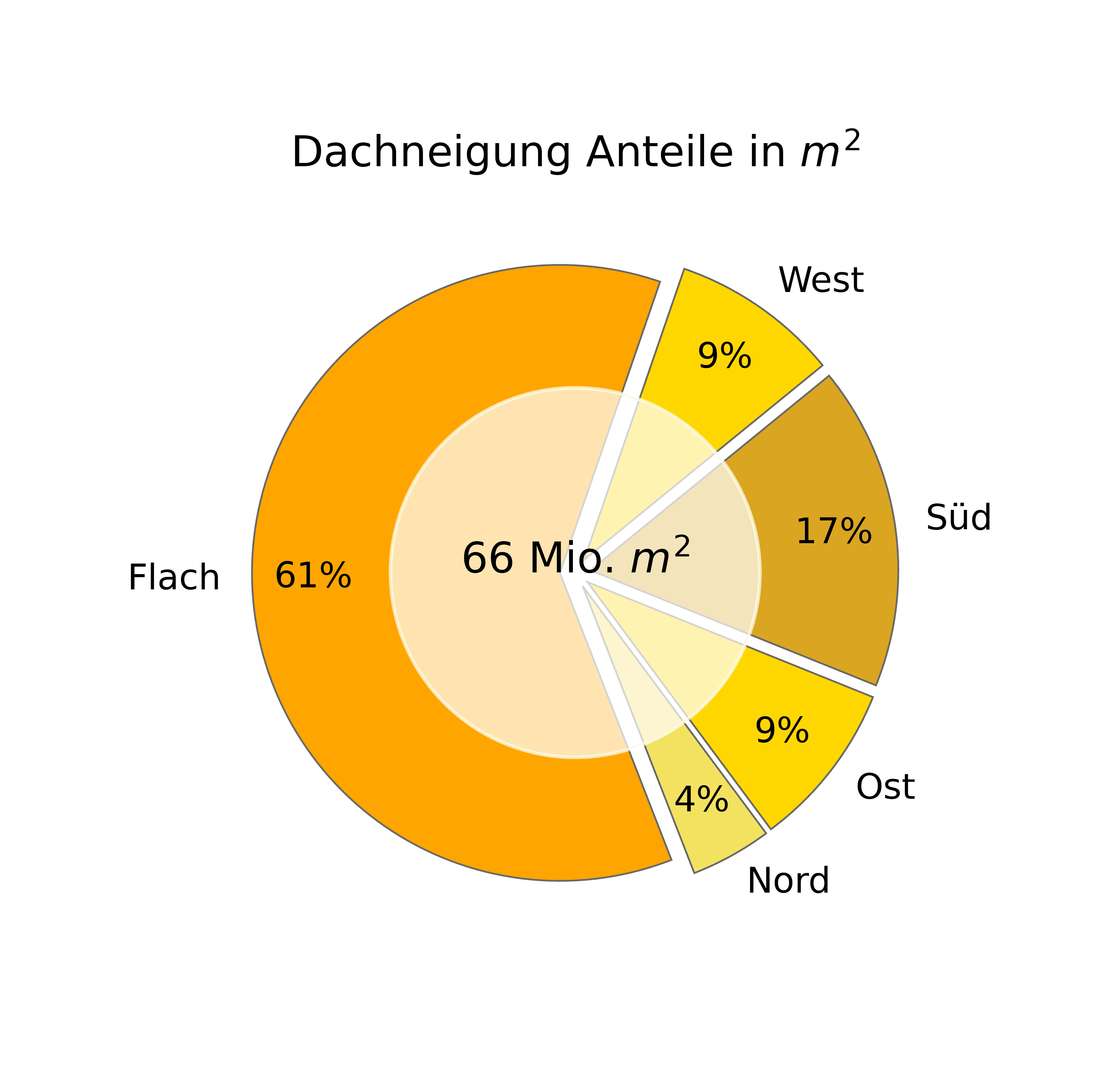
In urban areas, photovoltaic systems on rooftops can make a significant contribution to local green electricity generation. In Berlin, around 1.1 million partial roof surfaces were identified as suitable for solar electricity production. This corresponds to a total area of approx. 66 million m² on which a total capacity of 8,894 MWp of photovoltaics could be installed.
How much of Berlin's total electricity demand can be covered by pure solar power depends not only on the absolute expansion of installed capacity, but also on prevailing weather conditions and the temporal structure of electricity generation and consumption. In the best case, the latter coincide in time and equal amounts.
Energy Calculation
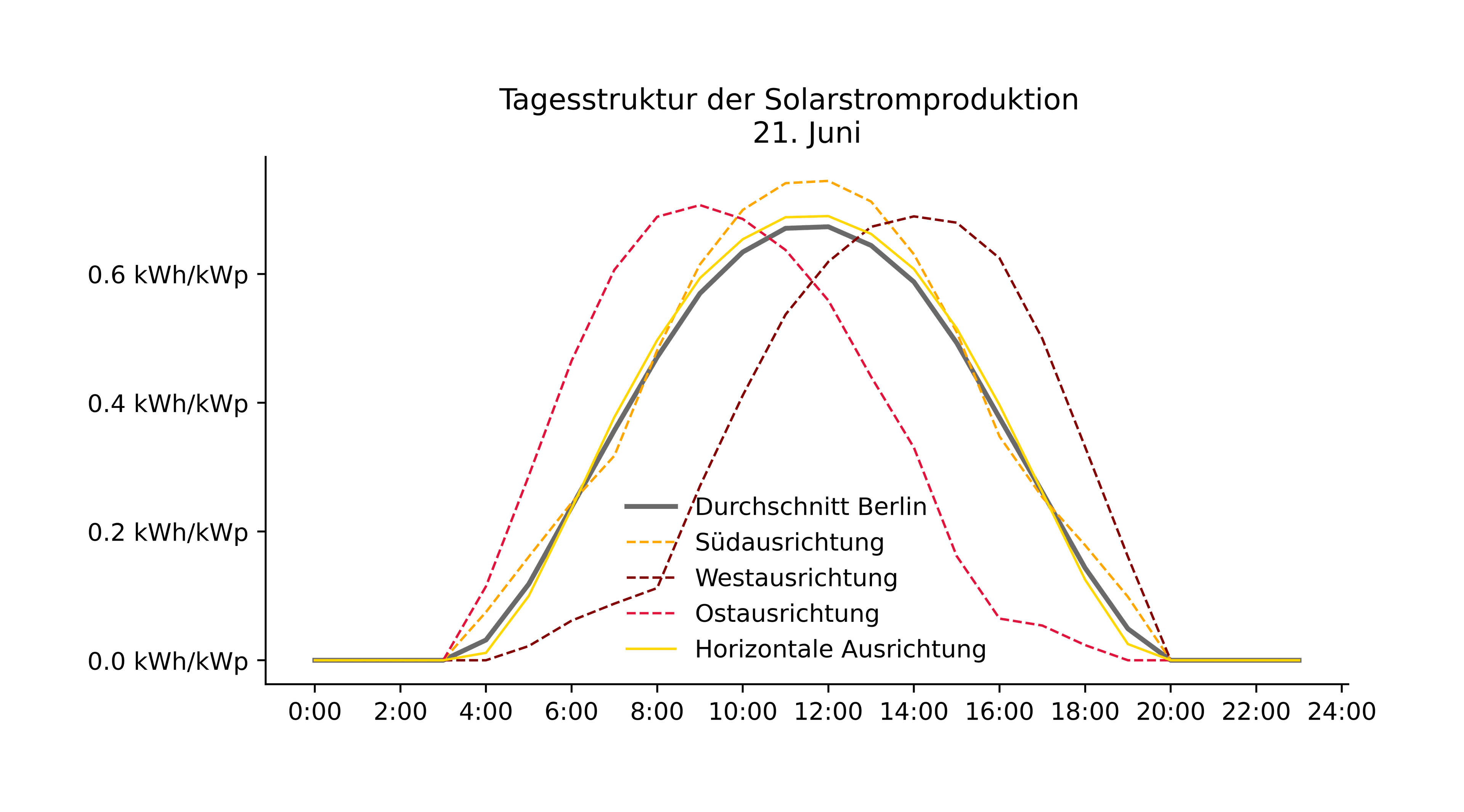
The temporal generation profile and absolute electricity production of a PV system varies greatly depending on inclination and orientation. For example, a south-facing orientation is optimal for maximizing annual total yield, but solar electricity production from systems with an east or west orientation is more compatible with the temporal electricity consumption pattern of a household, as higher production is achieved during morning and evening hours.
Daily structure of solar electricity production June 21
Daily structure of solar electricity production December 21

The temporal Berlin overall profile of solar electricity generation resulting from the detailed calculation of actual roof orientations compared to differently oriented individual systems under cloudless conditions.
Equally decisive for solar electricity production is the inclination of the respective roof surfaces. While photovoltaic systems on flat roofs can be set up at an optimal inclination angle of about 40° for total yield, for the remaining part of Berlin's solar potential, the inclination is predetermined.
For the calculation of solar electricity production scenarios, data on roof area, inclination and orientation from three-dimensional building data were provided by the Berlin Senate Department for Economics, Energy and Public Enterprises. To reproduce the temporal generation structure in detail, the 1.1 million partial roof surfaces were categorized by orientation and inclination into a total of 17,500 different roof types, with a south-facing setup assumed for flat roofs. For each of these groups, solar electricity production was simulated in quarter-hourly resolution.
Roof inclination shares in m²
Weather Scenarios
For a given expansion, solar irradiance and temperature primarily determine the possible electricity generation from photovoltaics. To quantify the probability with which Berlin can achieve various degrees of electricity self-sufficiency from solar power under different expansion scenarios, the solar power potential must be evaluated under a variety of possible weather conditions.
Using machine learning approaches from variate.energy, 10,000 synthetic weather years were generated, consisting of global and diffuse radiation components as well as outdoor temperature, in quarter-hourly resolution, to cover a complete spectrum of future local weather scenarios.
By combining synthetic weather scenarios with data on roof inclination, area and orientation, the respective solar electricity generation can be determined for each of the 17,500 identified roof types under individual weather scenarios and compared with electricity consumption data. This allows the generated weather scenarios to be evaluated with regard to the resulting electricity coverage rate from solar power.
A "favorable" weather year is defined as a synthetic weather year under which an electricity coverage rate in the top 10% of the probability distribution is achieved. A "poor" weather year has a coverage rate in the bottom 10%, and an "average" weather year has a coverage rate in the middle range. Monte Carlo methods can be used to determine how likely different degrees of self-sufficiency are under different expansion scenarios.
A self-sufficiency rate of 25% can already be achieved on average with an expansion of approx. 4,200 MWp. Under the set expansion target of 4,400 MWp, a self-sufficiency rate of at least 25% is achieved with a probability of 85%.
Contact
For questions about methodology or data usage, please contact Joachim Reinhardt.
Joachim Reinhardt
Co-founder of variate.energy
joachim@variate.energy